
Baltimore School Absenteeism
Limited Transportation Impedes School Success
Context
In my Master’s of Public Policy program this spring I worked with a group on a policy analysis of a pressing issue. My group initially focused on the shuttering of after-school and tutoring programs across Baltimore due to the expiration of Covid relief funding. By the end of semester, having explored some of the stark statistics regarding absenteeism and academic achievement in Baltimore City Public Schools (BCPSS), we had shifted our focus to transportation access as a foundational need with cascading effects. Below I share the executive summary of what turned into a 51 page policy analysis (including appendices). Many thanks to my colleagues and co-authors, Rebecca Kirvan and Samantha Fu. This was a huge team effort.
Executive Summary
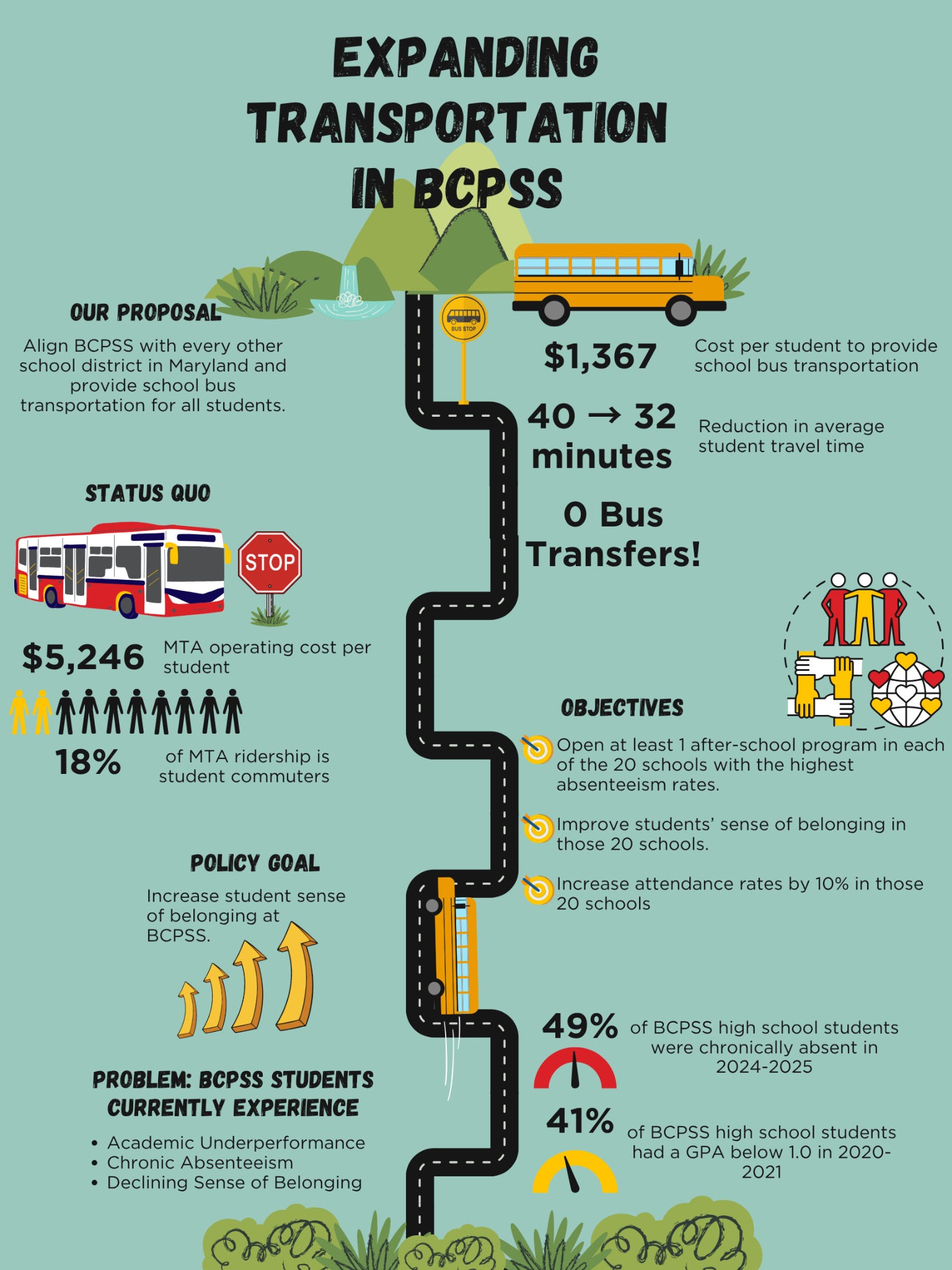
Baltimore City Public Schools (BCPSS) have the highest rates of chronic absenteeism in the state of Maryland, along with the lowest school survey scores and consistent academic underperformance. The lack of reliable school transportation leads to student disengagement, contributes to high drop out rates, and prevents participation in sports and after-school activities. On average, BCPSS students take 42 minutes to get to school each day using public transportation, and many face bus transfers that extend their trips to over an hour and a half.
The direct impact of this problem is inequitable access to the citywide school choice program, where the further a family lives from a particular school, the less likely they are to list that school on their choice application. It also leads to decreased earning potential and increased involvement in the justice system through truancy laws that negatively impact students’ futures.
Absenteeism imposes many negative externalities - negative consequences that are conveyed to a third-party as a result of a market transaction - on parents, commuters, and city residents. Parents face missed work hours when they have to drive their children to school because of bus delays. City buses become full and pass by students and commuters, reducing reliability for everyone and causing people to arrive late to work. Truancy enforcement relies on police and courts, leading to high taxpayer expenses and diversion of police resources from violent crime to tracking down teenagers who are not going to school.
To address the high cost of externalities, we propose that BCPSS expand school busing from only elementary students to include all K-12 students. This is estimated to reduce student travel time from 42 to 30 minutes on average while eliminating bus transfers, which often lead to greater delays or leave children waiting in unfamiliar neighborhoods. It will reduce congestion on public transportation, leading to more reliability for regular work commuters. Finally, it is estimated to cost an additional $1,322 per student to expand transportation to middle and high schoolers, while the Maryland Transit Administration (MTA) is already spending over $5,000 per student per year in operating expenses.
School transportation is an immediate and vital need, and it is the first step toward reducing chronic absenteeism. We recommend that BCPSS and the Board of School Commissioners allocate an additional $51 million (2.7% of the school budget) in the next annual budget to contract buses and provide safe, direct transportation for all students.
After removing the structural barriers that prevent equitable access to school choice and school participation, BCPSS can begin to address other student needs that contribute to disengagement. The district can expand extracurricular opportunities that improve mentorship and create positive adult relationships. However, until the transportation barrier is addressed, expanded educational interventions like after-school programs will have limited impact.
P.S. - If you like what you read, please share with anyone you think might be interested. If you really like it, I now have a Ko-Fi page set up if you’d like to buy me a coffee.